Global Assortment, Local Intelligence: Balancing Brand Consistency and Regional Demand

I was recently asked how a global brand can turn regional market insight into one global assortment. My answer: the best global assortments aren't imposed from head office, and they aren't assembled from every regional wish list either. They're built by listening early to the people who know each market best, asking them to back their ideas with evidence, and then making one coordinated decision.
Why can't one global assortment work everywhere?
Because consumer preferences, climates, price sensitivity and even the way a product is perceived change from one region to the next, so a collection that works in Europe may not work in Asia or North America.
Having spent more than a decade working with global footwear, apparel and sporting goods brands, I've seen that the challenge is rarely a lack of regional market knowledge. The challenge is getting that knowledge to the right decision-makers, in a consistent and commercially meaningful format, while there is still time to act on it. Nobody understands a regional market better than the teams operating in it.
That changes the question. It's no longer how to build a global strategy. It's how to build a global strategy that meets the requirements of each regional market.
The global vs regional assortment debate is often framed as a trade-off between brand consistency and regional demand. I don't see it that way. A global line that ignores regional differences doesn't make the brand more consistent, just less relevant. When regional teams have a voice in it, the global line becomes genuinely relevant across markets.
Why not give every region what it asks for?
Because saying yes to every regional request erodes margin, multiplies complexity and fills the line with SKUs that each sell too little to justify their cost.
The harder question is how to balance customer demand against assortment cuts and margins. My answer is that not every regional request will, or should, make it into the line. The goal was never for every region to get everything it asks for.
If it did, the line would lose the shape that makes it one brand, and the global team would lose the ability to weigh one region's request against another's. Every request should be gathered, looked at and evaluated. Some will go ahead and some won't.
The real goal is to give the global team the ability to make the best decisions, backed by real data submitted by every region, and to make them as one coordinated decision, early enough in the seasonal go-to-market calendar to influence the line before key development and commercial decisions are locked. So the question isn't whether regions should influence the global assortment. It's how.
How should regional teams influence the global assortment?
Regional teams should influence the global assortment as early as possible, through a structured request process where every request carries its commercial case, other regions can endorse it, and global merchandising makes a coordinated decision while the line can still change.
What we've seen work well with some of our customers is a process in five steps:
- Global line visibility. The global team shares the collection early enough for regional teams to evaluate it against their market requirements and identify potential gaps.
- Regional requests backed by data. Regional teams submit requests for new products, colorways or carry-overs, supported by commercial justification, expected sales and relevant market data. The commercial case should be complete at the point of submission.
- Cross-regional endorsement. Every request is visible to other regions, allowing them to identify shared opportunities, endorse requests and contribute their own expected sales volumes.
- Global evaluation and decision. Global merchandising evaluates the consolidated requests against brand strategy, commercial potential, margin requirements and operational feasibility. The decision remains with the people, supported by data.
- Decision communication and feedback. Regional teams are informed of which requests have been approved or declined, together with the rationale behind each decision. This ensures transparency, accountability and alignment across the business.
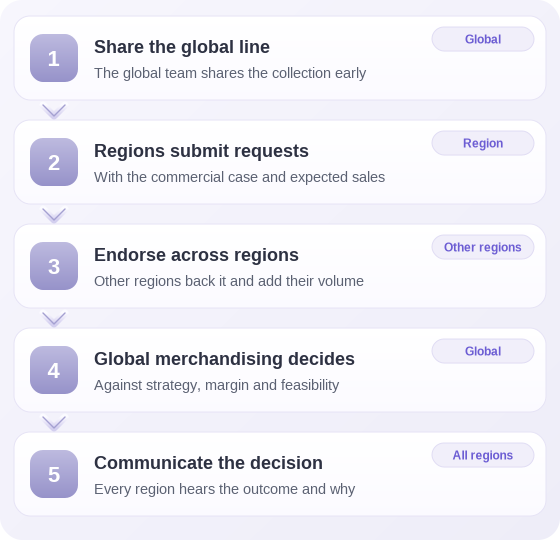
Each step adds evidence, so by the time a regional assortment request reaches global merchandising, the conversation is about trade-offs, not about who argued hardest.
None of this works if regional feedback lives in email threads, slide decks and spreadsheets. Regional teams need a voice as early as possible, and that voice has to reach the people who make the decision while it can still change the line. That takes one central place where the global line is shared, requests are collected with their data, other regions can endorse them, and each request moves from the regional team to global merchandising and on to the teams who develop the line, without getting lost along the way.
That is the workflow we built Trasix's Regional Execution around. Not to make the decision for anyone, but to connect the people who need to make it.
Example: the region that wants purple
A regional team asks for purple. The usual next step is for the global team to go back and ask why. I'd rather that question never needs asking. The region should justify the request when it submits it, right there and then.
So when global merchandising looks at the request, the question is simple: if we give this region purple, what are they going to do with it? Which products, and how many do they expect to sell?
Then the request becomes visible to every other region. Another region might look at it and say: they're right, and if you do purple, we can sell another 20,000 units. That endorsement changes the decision. One region's request has become a coordinated opportunity, with a stronger combined demand forecast.
The point isn't purple. It's that a request with its case attached becomes information the whole business can use, rather than a negotiation between one region and head office.
Who decides what?
Regional teams bring the demand signal and the commercial case, other regions add their view, and global merchandising owns the final decision on the global line.
| Global merchandising | Regional teams | Other regions | |
|---|---|---|---|
| Submits | The global line, shared with regions as early as possible | Regional assortment requests (new products or carry-overs) with the commercial case and expected sales | Endorsements, with their own expected sales where relevant |
| Reviews | Every request, case and endorsement side by side | Feedback and decisions on their own requests | Requests from other regions that could work in their markets |
| Decides | What enters, stays in or leaves the global line | What to request and how strongly to back it | Whether to endorse and commit volume |
Clear ownership matters as much as the process. When regions know their case will be read, and global merchandising knows the case will arrive complete, both sides spend less time negotiating and more time on the line.
Global vs regional assortment: how do the three models compare?
The coordinated model is the one that balances all three: brand consistency, regional sales and margin.
| Imposed globally | Every region gets everything | Coordinated | |
|---|---|---|---|
| Brand consistency | Strong | Weak: the line loses its shape | Strong: one global core, controlled regional additions |
| Regional sales | Missed demand in markets that differ | Strong on paper, diluted by low-volume SKUs | Strong where the case is proven |
| Margin | Increased risk of markdowns due to demand mismatch | Squeezed by complexity and minimums | Protected when endorsing regions pool enough volume to reach factory minimum order quantities |
| Speed | Fast to decide, slow to correct | Slow: every request is negotiated separately | Fast: the case arrives with the request |
The imposed model looks efficient until the markdowns arrive. The "everything" model looks generous until margin review. Coordination is the model that holds up best across all four.
How do you know it's working?
Track six KPIs: two show whether regional input reaches the line in time, and four show whether it pays off commercially.
Regional adoption rate: the share of the global line each region takes into its own assortment. It measures how well the global line aligns with regional assortment requirements.
Time to decision: the number of days from a regional signal (a request, a sell-through trend, a buyer comment) to a global decision on it. It measures how efficient the merchandising decision-making process is.
A rising regional adoption rate tells you the global line is getting more relevant to each market. A falling time to decision tells you regional input is reaching the line plan while it can still change the season. If adoption is low in one region, look at the requests that region has submitted. If time to decision is long everywhere, look at where requests wait.
The other four KPIs test whether the requests that made it into the line were worth it:
- Regional request sell-through: actual consumer demand for products introduced through regional requests.
- Forecast vs. actual sales: how accurate the commercial justification from regional teams turned out to be.
- Gross margin performance: the financial contribution of regional assortment additions.
- SKU productivity: whether the added assortment complexity generates enough commercial value.
Forecast vs. actual sales matters most of the four, because it shows whether the accountability built into each request holds up.
All six depend on the same thing: every request, case and decision collected in one central place. When regional feedback is scattered across inboxes and spreadsheets, you can't measure it, and you can't act on it in time to shape the line. When it is gathered in one system, these KPIs are easy to track, and they show you where requests are waiting and which ones paid off.
About the author. Andre Labaki is the Founder & CEO of Trasix, the B2B platform that fashion, footwear and sporting-goods brands use to build, visualize, manage and sell the line next to their planning tools. He founded Trasix after seeing, in 2011, how a global sportswear brand built its catalogs by hand and stitched retailer orders together across Excel files before anything reached a factory. Before that, he built software for banks.
Continue reading: Market Segmentation · the regional assortment planning guide · assess your merchandising maturity
If you want to see how the global line, regional requests, commercial cases and endorsements come together in one place, so regional teams are heard early and decisions move quickly from region to global, book a Trasix demo.
Frequently asked questions
What is a global core assortment?
The global line is everything a brand offers across its markets. The global core assortment is the mandatory part of that line, which every region carries. It defines what the brand stands for in every market, and regions build on it with their choices from the rest of the line and their regional assortment requests.
How much of the global line should regions be able to change?
There is no single right percentage. Regions should be free to choose from the wider global line and to request additions when their commercial case is strong, but the global core assortment should stay protected. The regional adoption rate shows whether that balance is working.
What should a regional assortment request include?
A regional assortment request should include the product (new or carry-over), why the market needs it, how much the region expects to sell, and the data behind it. It should be complete when it is submitted, so other regions and global merchandising can evaluate it without chasing information.
Who makes the final assortment decision, global or regional?
Global merchandising makes the final decision. Regional teams shape it by submitting requests with their commercial case, and other regions shape it by endorsing requests that could work in their markets.
How do you measure whether regional input is improving the line?
Track six KPIs: regional adoption rate (alignment between the global line and regional assortment requirements), time to decision (efficiency of the merchandising decision-making process), regional request sell-through (actual consumer demand for products added through regional requests), forecast vs. actual sales (accuracy of the regional teams' commercial justification), gross margin performance (financial contribution of regional additions) and SKU productivity (whether added assortment complexity generates enough commercial value).