I Already Have PLM. Why Do I Need Trasix?
For many fashion, apparel, footwear, and retail brands, Product Lifecycle Management (PLM) software is already the foundation of the business. It manages sourcing, tech packs, supplier workflows, compliance, approvals, prototyping, and the core product creation process. PLM creates structure, governance, and consistency across development teams, and for most organizations, it remains the operational backbone of the business.
So the question comes up often: if I already have PLM, why do I need Trasix?
The answer is simple. Because PLM was built to control product creation. Trasix was built to execute the assortment.
The Bottleneck to Speed Is Executable Data
Most brands do not struggle because they lack a PLM. They struggle because the bottleneck to speed is not product creation — it is executable data.
The moment teams move into line planning, merchandising, regional assortments, campaign execution, and sell-in, they leave the PLM and go back to spreadsheets, slides, whiteboarding tools, and endless back-and-forth. They also start pulling information from MFP and AFP tools, financial planning systems, regional forecasts, and sales inputs that live outside the core product workflow.
That is where time gets lost.
The issue is not planning. It is disconnected tools that do not talk to each other.
Financial line plans live in one place. MFP and AFP data live somewhere else. Merchandising decisions happen in separate tools. Collaboration happens in disconnected systems. Placeholder styles, delivery dates, segmentation, sample requests, and change logs get managed manually. Leadership reviews static snapshots that are already outdated the moment they are shared.
Everyone is working, but no one is working from the same source of truth.
When teams leave the system to make decisions, the result is fragmented data, manual upkeep, inconsistent integrations, and late changes that cannot execute. Regional assortments drift from the global line plan. Merchants over-assort because visibility comes too late. Sell-through suffers, markdowns increase, and teams spend more time reconciling versions than actually driving the business forward.
Adding more process does not solve that. Connecting execution does.
What PLM Does Well—and Where It Stops
PLM is critical for product creation, and it should remain that way. It is designed to manage product data, supplier collaboration, approvals, compliance, and development workflows. It gives teams control over how products are built.
But product creation is only one part of the go-to-market lifecycle.
The moment brands move into assortment planning, merchandise financial planning, assortment financial planning, regional execution, campaign alignment, and commercial readiness, most PLM systems stop being the place where decisions happen. Teams move outside the system because they need flexibility, visual collaboration, and faster decision-making.
That gap is where most brands lose speed — not because PLM failed, but because PLM was never built to own assortment execution.
Flexibility Equals Speed
Speed in fashion does not come from adding more approvals or forcing teams into rigid workflows. It comes from the ability to make decisions quickly and execute them without friction.
That requires flexibility.
When a regional team needs a localized assortment change, when merchandising needs to react to sell-through signals, or when leadership asks for a late campaign shift, the system has to move with the business. If every adjustment requires a ticket, a workaround, or another spreadsheet, speed disappears.
Rigid systems create delays because they are built to protect process first. Flexible systems protect execution.
Trasix is built around that principle.
Instead of forcing brands to adapt to software limitations, it adapts to the way teams actually work. Merchants can build assortments visually, planners can align against MFP and AFP targets in real time, regional teams can execute without breaking the global line plan, and leadership can review live decisions instead of outdated snapshots.
Flexibility is not a convenience feature.
It is what allows teams to move at market speed.
Trasix Fills the Gaps PLMs Leave Behind
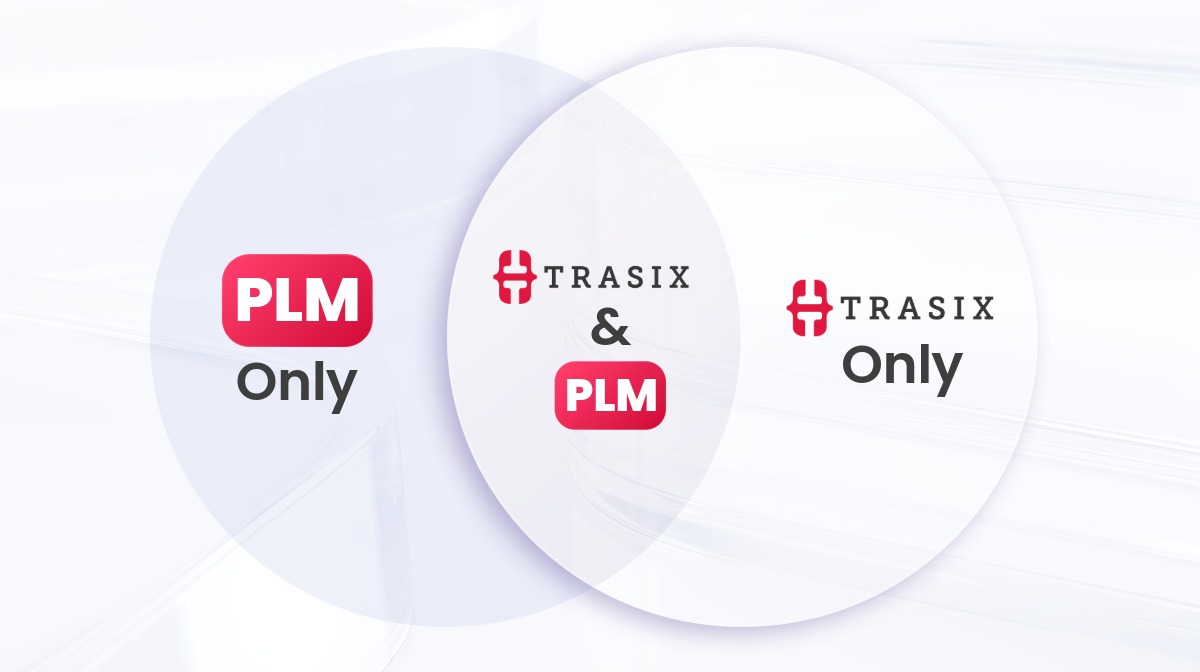
Trasix does not replace your PLM. It fills the gaps PLMs leave behind.
PLM remains the backbone, while Trasix becomes the execution layer that connects planning to what actually gets sold. It is the layer where assortments are built visually, where MFP and AFP inputs connect directly to merchant decisions, where regional assortments stay aligned to the global line plan, and where campaign timing connects to product readiness.
Instead of teams managing five disconnected workflows, Trasix creates one connected environment where decisions happen with live data and full visibility.
This is where speed is protected.
PLM Is the Backbone. Trasix Is the Nervous System
The easiest way to understand the relationship is this: PLM is the backbone, and Trasix is the nervous system.
PLM provides the structure. Trasix carries the signals, connects teams, and turns strategy into action. It connects merchandising, design, sales, planning, regional teams, and leadership so decisions move faster and execution stays aligned.
More importantly, it gives teams the ability to work with speed, confidence, and visibility that traditional systems simply were not built to support.
Instead of waiting for updates, teams work with live data. Instead of rebuilding the same decision across five systems, execution happens once. Instead of reacting late, teams gain visibility early enough to act.
That is where better margin comes from.
What This Looks Like in Practice
Trasix supports the workflows that happen after product creation but before revenue is realized.
This includes:
- Collaboration in an endless canvas
- Financial line planning with MFP and AFP integration
- Merchandise assortment management
- Product segmentation and regional execution
- Campaign planning and launch visibility
- 3D visualization and digital sell-in
- Built-in change logs and governance
- Custom analytics and reporting
Instead of forcing teams to work around the system, Trasix creates a connected environment where design, execution, and decision-making happen together.
All of it connects directly to your existing PLM, ERP, DAM, CRM, MFP, AFP, and sales systems. It is not another disconnected platform. It is a connected assortment execution layer.
Why Flexibility Matters
Most enterprise systems are rigid by design. Every customization becomes a project. Every workflow adjustment becomes a delay. Every request for flexibility becomes another cost.
That model creates friction at exactly the moment brands need speed.
Trasix works differently. It is built to adapt to your process, not force you into ours. That means faster implementation, real support, competitive pricing, and configuration without compromise. Brands do not need to lower their standards to fit inside rigid software.
The platform adjusts to how the business actually works, especially for global organizations managing multiple regions, brands, channels, and distributor networks.
Better Execution Protects Margin
This is not about adding another tool. It is about improving business performance.
Faster execution means teams stop spending time reconciling versions and start spending time making decisions. It means stronger assortment accuracy, earlier visibility into demand shifts, better regional alignment, and better sell-through.
The cost of inaction is measurable:
- Missed revenue from under-assorting
- Operating profit lost to over-assorting
- Delayed decisions that impact launch timing
- Time wasted across spreadsheets, slides, and manual reconciliation
One version. Live data. Greater control. Stronger alignment. Better visibility. And the power to make faster, smarter decisions across the entire go-to-market process.
Final Thought
PLM should remain the backbone of your business.
But backbone alone does not create speed. Execution does.
Greater control. Stronger alignment. Better visibility. And the power to make faster, smarter decisions across the entire go-to-market process.